Mizuki Uchiyama
NY1 TV Package: https://vimeo.com/1144674298/307364e3d9
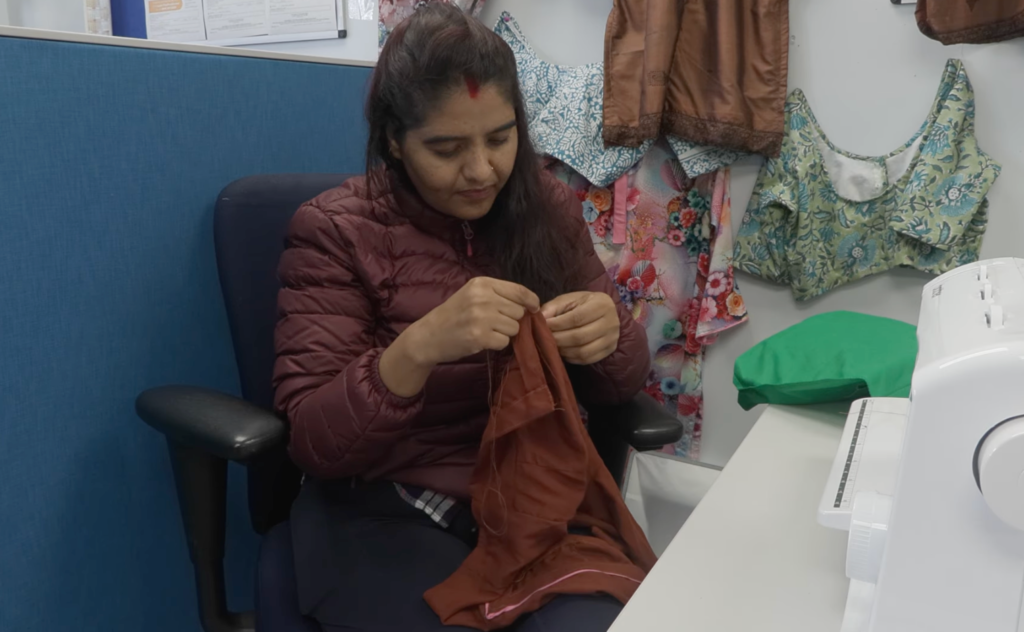
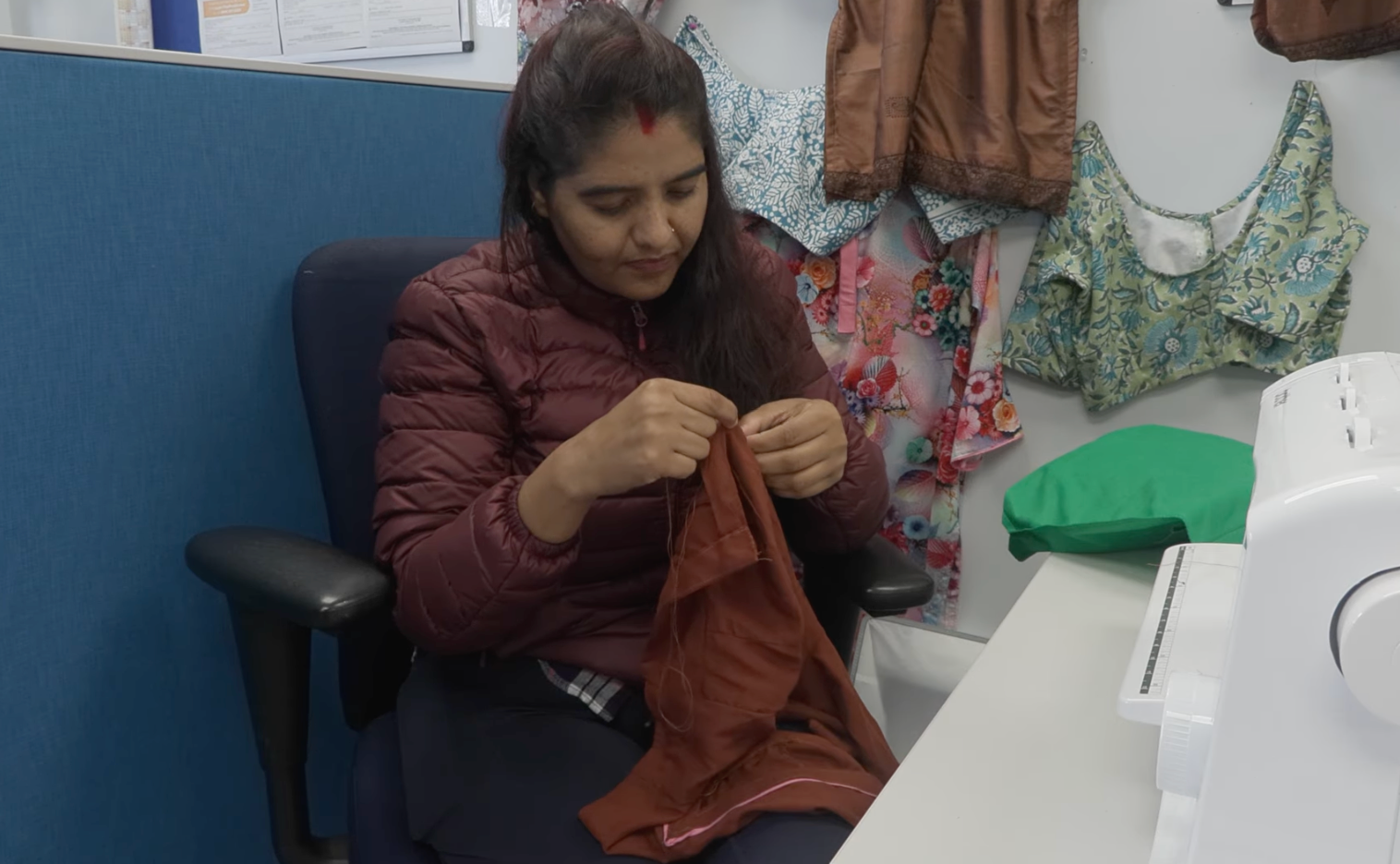
Kalpana Tiwari from Nepal is taking a sewing class at SACSS
Inside the sewing classroom at the South Asian Council for Social Services (SACSS) in Flushing, bright fabrics spill across tables as women lean over their work, speaking in Bangla, Nepali, Hindi, and sometimes in hesitant English. Baby Miriam, 48, from Bangladesh lifts a dress she finished in just two days. She laughs shyly as she smooths the hem.
“Language, language,” Miriam says. She describes the struggle of navigating hospitals without language support, filling out school forms she cannot read, depending on her children to translate, and accepting low-wage jobs because she cannot communicate with employers.
“Back home, I worked, but here… nothing,” she said in her new language. “Now my teacher help. Little, little English. I am so happy tailoring, English, computer… good. Now I feel something is possible.”
For many of the women in the room, this class is the first place in New York where they feel understood, linguistically, culturally and emotionally.
Scenes like this inside a sewing classroom in Queens reflect a reality that rarely surfaces in public conversations shaped by the “model minority” myth. Asian communities are often underfunded and overlooked. Against this backdrop, South Asian Council for Social Services (SACSS), a grassroot organization in Queens serving South Asian immigrants, has become an essential lifeline for residents.
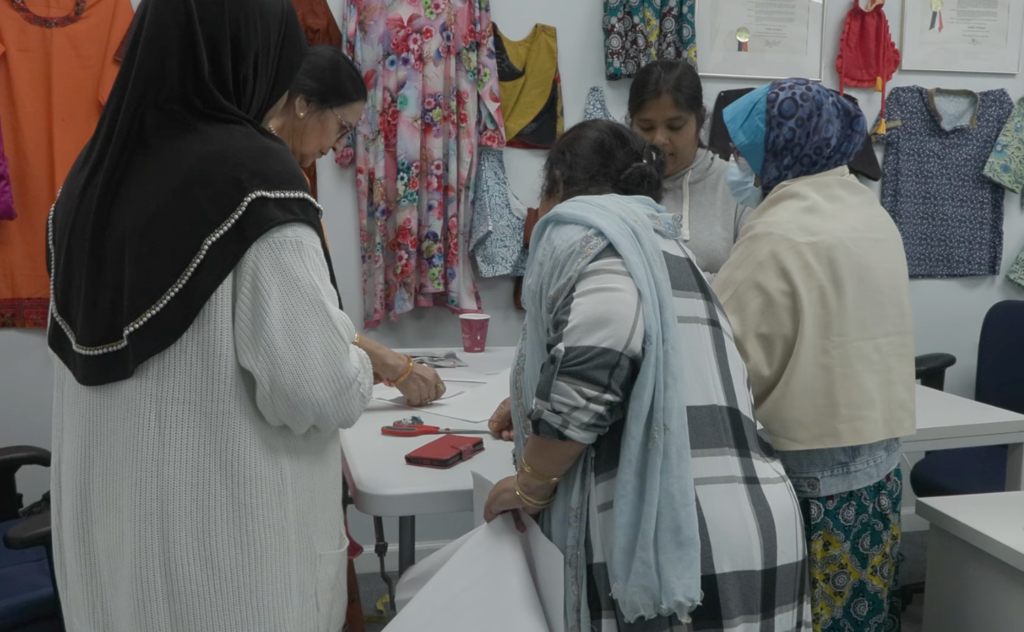
Students gather around the teacher
When Kalpana Tiwari, 32, arrived in New York from Nepal seven years ago, she could barely ask for directions. Afraid to speak English and unsure how to navigate the subway, she often stayed home with her toddler, hoping things would somehow get easier with time.
The pressure to succeed, to earn money and give her children a better education, felt constant. But with little English and no local work experience, success seemed out of reach.
“People think we Asians come here and do well,” says Tiwari. “But I was scared. I didn’t understand anything.”
Asian residents experience poverty at nearly the same rate as Black and Latino New Yorkers, around one in four. By comparison, about 13% of white New Yorkers live in poverty. Within Asian communities, poverty rates vary sharply.In the New York metro area, poverty affects about 6–7% of Indian and Filipino Americans, compared with rates of around 20% or higher among Mongolian, Burmese and Bangladeshi Americans.
SACSS program director Mary Archana Fernandez says these stories reflect long-standing gaps in the way immigrant families receive services. When the organization was founded in 2000, almost no city agencies offered support in South Asian languages, a major oversight in Queens, home to one of the largest South Asian populations in the country.
“People think South Asians and Asians are the model minority, doing very well, doctors and engineers,” Fernandez says. But she says that narrative obscures a large group of immigrants who struggle to access basic services, including language support, healthcare and public benefits.
SACSS now offers services in 20 languages, ranging from Nepali and Bangla to Mandarin and Urdu. Each year, the community-based nonprofit serves more than 300,000 underserved New Yorkers, providing support that ranges from English and computer classes to help navigating Medicaid and SNAP applications, workforce training and access to a food pantry, often all in the same visit.
As part of that broader safety net, SACSS launched its Stitch with SACSS tailoring program in 2023. The initiative is designed to train more than 60 immigrant women each year through four 10-week sessions, helping participants earn income from home while navigating childcare responsibilities and language barriers.
“When our clients walk in, they feel this is a safe place,” Fernandez says. “They meet someone who speaks their language, looks like them, understands their culture. That changes everything.”
SACSS staff also help immigrants re-enter the workforce by evaluating foreign degrees, navigating licensing requirements, and preparing resumes. Many women start with sewing because it allows them to earn income from home while caring for children.
“It’s not just skills,” Fernandez says. “It’s dignity.”
Ziyao Tian, a research associate of race and ethnicity research at Pew Research Center, says the challenges South Asian immigrants face are rooted in systemic gaps.
Tian says language access remains one of the biggest barriers. Almost 60% of Asian-language speakers in New York City have limited English proficiency, yet many hospitals, schools and government agencies still lack adequate translation or interpretation services.
Pew Research’s focus groups back this up. Many participants said they were unsure how to access public benefits because materials were not in their languages
Even funding itself is inequitable. Asian New Yorkers make up 18% of the city’s population but receive only 6% of social-service funding. “People don’t understand that Asian poverty exists, and when people don’t see a problem, they don’t fund it,” Tian says.
And the urgency is growing, Fernandez says. “As housing prices rise, many immigrant families are being pushed out to the suburbs, where culturally competent services are far less accessible,” Fernandez says.
Tian says highly educated immigrants with degrees from South Asia struggle to re-enter their fields because their credentials are not recognised. Parents take low-wage jobs that offer no stability because they cannot communicate with English-speaking employers. Many families rely on children to translate for them, a burden that complicates everything from school communication to medical care. Others described working multiple jobs to support family abroad while barely affording rent.
Those pressures have intensified in recent years. And now, under the Trump administration, Fernandez says many immigrants avoid seeking public benefits because of fears tied to federal immigration policies – fears that have deepened amid shifts in federal guidelines and stepped-up enforcement.
“SACSS staff took extra care to reassure anxious clients by clearly explaining how public benefits work, what information is required, and what will and will not be shared with immigration authorities,” Fernandez says. “We want to make sure people feel safe. Trust is everything.”
SACSS’s approach, language support, practical skills, and culturally responsive programming, directly targets these gaps.
As the class winds down, the women pack away fabric and colours, chatting lightly as they gather their belongings. Kalpana folds her finished blouse into a plastic bag with meticulous care. Later this month, she says, she hopes to apply for part-time sewing jobs, a step she once thought out of reach.
“Now I start my job,” she says, beaming. “I’m confident. Always thankful.”